Sea Burial | Sea Scattering Funeral Services

Scattering of Ashes at Sea, also known as Sea Burial

When it comes to your last goodbye, we at Singapore Funeral & Casket Services understand that you value simplicity, respect, and environmental consciousness above all else. If you’re looking for a special and peaceful way to remember your loved ones, we offer a sea burial option that is both ecologically responsible and deeply moving.

The Final Resting Place of Memories at Sea

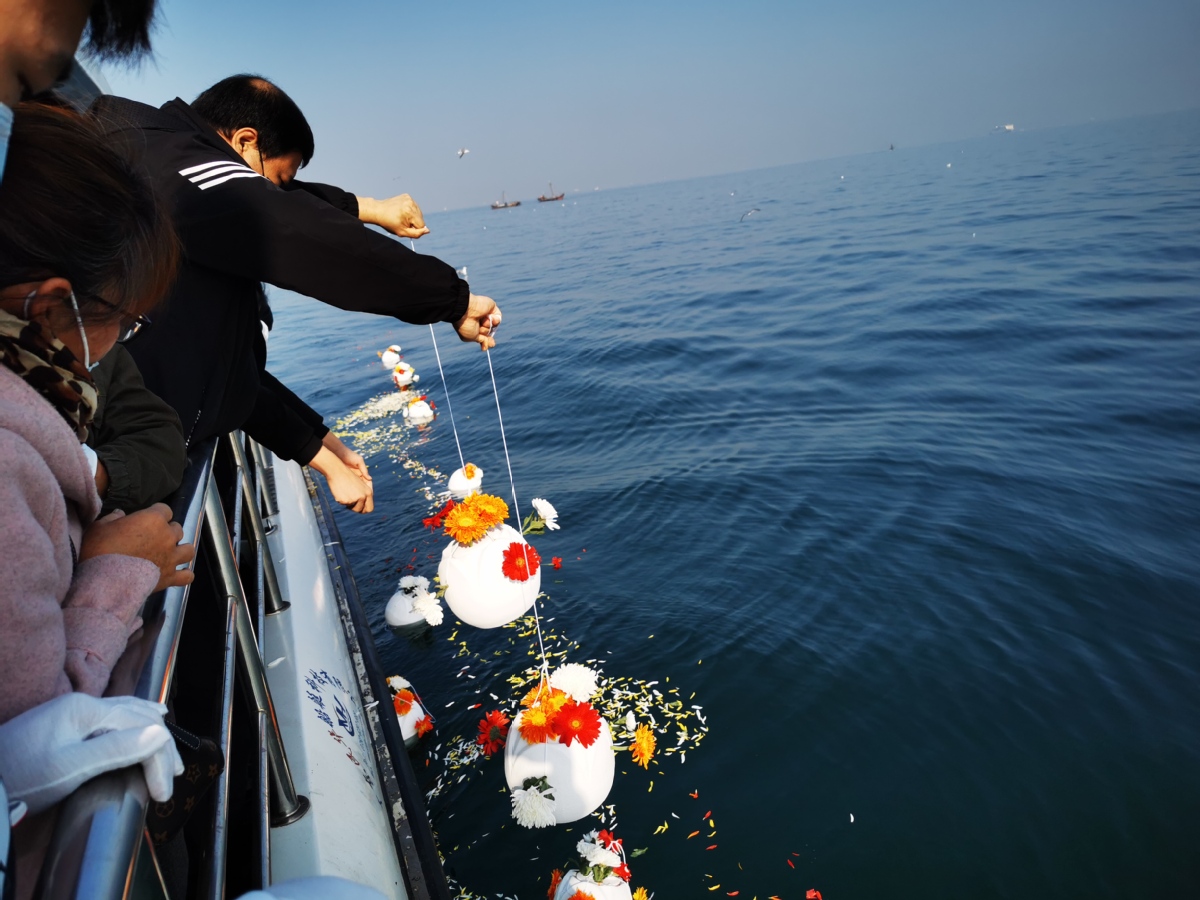
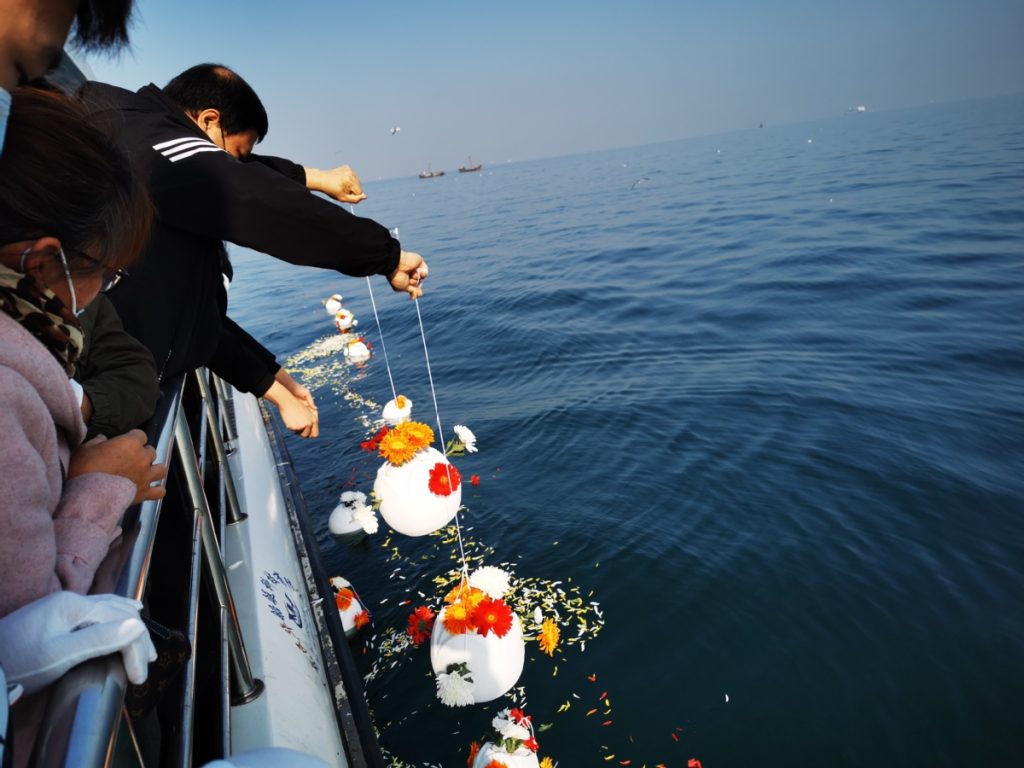
Those seeking a simple and inexpensive funeral have found sea burial to be an increasingly attractive option in recent years. Contrary to the dramatic scenes often portrayed in films, a sea burial in Singapore is a peaceful and heartfelt ritual that involves placing cremated ashes into a biodegradable sea urn. This urn floats gently on the water’s surface before naturally dissolving, offering a comforting and serene farewell.

Because we are committed to protecting the environment, Singapore Funeral & Casket Services uses only biodegradable sea scattering urns. Our eco-conscious approach ensures that we remain responsible stewards of nature, even in our final goodbyes.

Sites of Sea Burial in Singapore

With our sea burial services, you and your loved ones may be escorted by boat to a tranquil location in Singapore, where the ashes of the deceased can be respectfully scattered. You have two beautiful departure points to choose from for this meaningful ceremony:

Marina South Pier

A quiet location with the city skyline in the background, providing a serene starting point for your loved one’s final journey.

Location: 31 Marina Coastal Dr, Singapore 018988

Changi Pier

Set against a peaceful coastal backdrop, this location along the Changi beachfront offers a scenic and reflective atmosphere for a heartfelt farewell.

Location: 51 Lor Bekukong, Singapore 499172

NEA Regulations For Sea Burial in Singapore

In Singapore, if you’re planning a sea burial, it’s important to follow the regulations set by the National Environment Agency (NEA). Ash scattering can be done any day of the week, including public holidays, but it must take place between 7 am and 7 pm.

You can choose to scatter the ashes at sea within an approved site 2.8 km south of Pulau Semakau, which is designated by the NEA for such purposes.

You’ll need to get approval from the NEA beforehand, so be sure to apply early and have the necessary documents ready. These rules help ensure the process is carried out respectfully and in line with environmental guidelines.

Sea Burial Service Includes:

At Singapore Funeral & Casket Services, our sea burial package is thoughtfully arranged to provide a smooth and respectful farewell for your loved one. Our service includes:

  • Rental of a bumboat or yacht
  • Arrangement and booking of sea burial permits with the NEA
  • Cremation fee at Mandai Crematorium
  • Ash collection service
  • Fresh flowers or petals for scattering at sea
  • Manpower to collect the cremated remains and deliver them directly to the ferry terminal (families may also choose to collect the ashes themselves)

To personalise the farewell, you may also consider optional add-ons such as:

  • A biodegradable urn
  • A short ceremonial session based on your religious traditions
  • Enlarged photo of the deceased

For any other specific requests, feel free to call our 24-hour helpline at 8900 0000. Our dedicated Funeral Directors are here to support you and ensure everything is handled with care and minimal stress.

Step-by-Step Procedure for Sea Burial in Singapore

Step-by-Step Procedure for Sea Burial

At Singapore Funeral & Casket Services, we guide you through every step of the sea burial process to ensure it is smooth, respectful, and stress-free for you and your family.

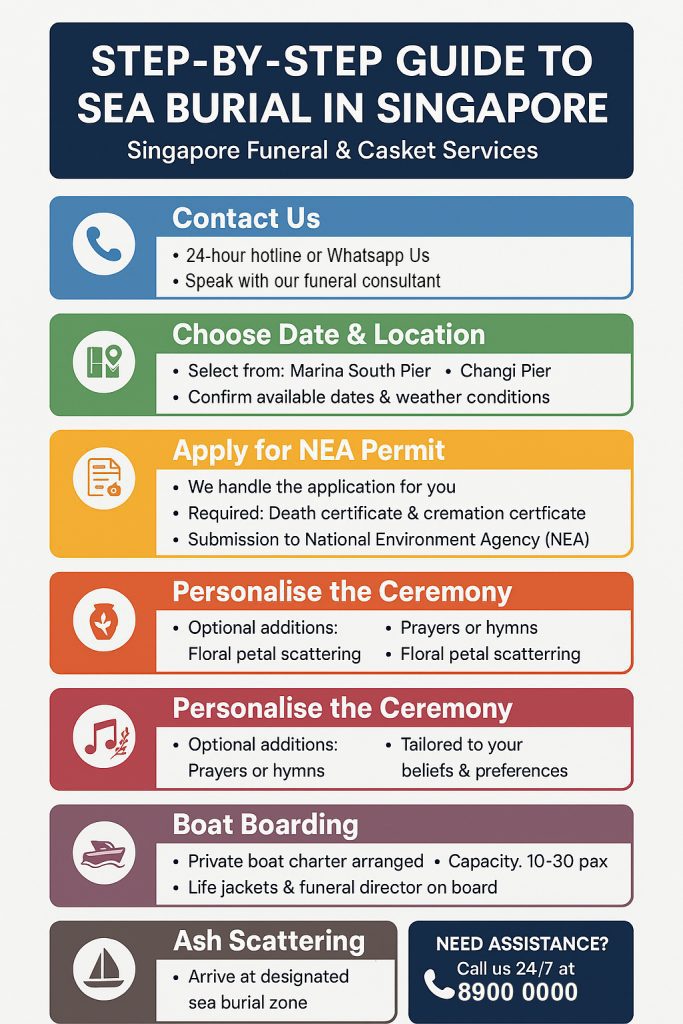
Step 1: Contact Our Funeral Consultant

Reach out to us via our 24-hour hotline or WhatsApp to express your interest in sea burial. Our consultant will explain the process, answer your questions, and arrange an initial discussion—either in person or over the phone.

Step 2: Select a Date and Preferred Location

Choose a suitable date for the sea burial. We will check boat availability and weather conditions for either Marina South Pier or Changi Pier, based on your preference.

Step 3: Documentation and NEA Permit Application

We will assist you in applying for the National Environment Agency (NEA) sea burial permit, which is required for the scattering of ashes in Singapore waters. This typically includes the death certificate and cremation certificate.

Step 4: Preparation of the Ashes and Sea Urn

We arrange for the collection of ashes from the crematorium or from your home. The ashes are then respectfully placed into a biodegradable sea urn, which will dissolve naturally in the water.

Step 5: Personalisation of the Ceremony

You may choose to include personalised elements such as:

  • Religious prayers or rituals
  • Singing of hymns or songs
  • Eulogies or readings
  • Floral petals to accompany the urn

We work closely with you to design a ceremony that honours your loved one’s wishes and values.

Step 6: Boat Charter and Boarding

On the day of the ceremony, your family and guests will board a private chartered boat, usually accommodating 10–30 people. Safety equipment and life jackets will be provided. Our funeral director will be present to guide the proceedings.

Step 7: Ash Scattering Ceremony

Once the boat reaches the designated sea burial area, the ceremony begins. After a short tribute or moment of silence, the biodegradable urn is gently released into the sea. Family members may also scatter flower petals or say final words.

Step 8: Return to Shore and Aftercare

After the ceremony, the boat will return to the pier. We provide optional memorial keepsakes or digital video coverage if requested. Our team remains available for any post-ceremony assistance or grief support you may need. The whole process will take approximately 2 hours, not taking into account the time taken for ceremonies.

Our Sea Burial Service

At Singapore Funeral & Casket Services, our sea burial service includes everything needed to ensure a respectful and meaningful goodbye. We handle the full process—NEA sea burial permit applications, ash collection, boat charter, biodegradable urns, floral arrangements, and more.

Our compassionate team is here to lift the logistical burden during this difficult time, giving you space to grieve, reflect, and honour the memory of your loved one.

We understand that every family is unique. That’s why we offer personalised sea burial and funeral services that respect your specific beliefs, preferences, and traditions.

Whether you’re seeking a prayer session akin to a Christian funeral or a secular tribute similar to a free-thinker ceremony, we will help you create a sea burial experience that feels emotionally resonant and sincere.

Engage Singapore Funeral & Casket Services for Sea Burial in Singapore

With Singapore Funeral & Casket Services, your loved one’s journey doesn’t end—it flows gently onwards, in harmony with the natural world. As the sea cradles their ashes, we offer you a meaningful, eco-friendly, and dignified opportunity to say goodbye.

If you’re looking to honour your loved one with an ash scattering at sea that respects both memory and environment, contact us today. Our caring team is here to support you through the entire process and deliver a service that aligns with your values and wishes.

To learn more or to arrange a sea burial service in Singapore, please call our 24-hour hotline at 89000 000, send us a WhatsApp message.

Frequently Asked Questions

1. Can you conduct a sea burial in Singapore?

Yes, sea burial is allowed in Singapore. The National Environment Agency (NEA) permits ashes to be scattered at sea within a designated area—2.8 km south of Pulau Semakau. You’ll need to apply in advance for approval, and the scattering must take place between 7 am and 7 pm, including public holidays. Only cremated remains (ashes) can be scattered—not whole bodies.


2. What is the price of a sea burial?

The cost of a sea burial in Singapore varies depending on the service provider and the type of vessel used. On average, it can range from $300 to $1,500 SGD. The price usually includes rental of a bumboat or yacht, permits, floral arrangements, and assistance with collecting the ashes. Optional add-ons like biodegradable urns or religious ceremonies will cost more.


3. What is the process for carrying out a sea burial?

First, the deceased is cremated. After cremation, the family applies to the NEA for permission to scatter the ashes at sea. On the appointed day, a chartered boat or yacht will take the family to the approved scattering site near Pulau Semakau. There, the family can perform a short farewell, often involving loose flowers or flower petals. The ashes are either poured directly into the sea or placed in a biodegradable urn that dissolves naturally in water.


4. How much does it typically cost to have a sea burial in Singapore?

A typical sea burial package in Singapore starts from around $380 SGD for a basic bumboat trip and can go up to $1,500 SGD for a private yacht with full ceremonial arrangements. If you include cremation fees, flower petals, transport, and ceremonial services, the total cost may increase accordingly.


5. What occurs to the body once it’s buried at sea?

In Singapore, only ashes are allowed for sea burial, not full bodies. Once the ashes are scattered, they disperse into the sea over time. If a biodegradable urn is used, it floats briefly and then sinks, breaking down naturally without harming the marine environment. This method is seen as eco-friendly and symbolic, as the remains return to nature.


6. What are the burial expenses like in Singapore?

Burial in land-based cemeteries in Singapore is far more costly and limited. A burial plot at Choa Chu Kang Cemetery costs around $940 SGD, and it only lasts 15 years, after which the grave may be exhumed. In comparison, cremation costs around $100 SGD at Mandai Crematorium, and sea burial can be a more affordable and space-saving option.

7. What to Wear to a Burial at Sea

When attending a sea burial in Singapore, it’s important to dress in a manner that is both respectful and practical. Opt for modest, conservative clothing in dark or muted colours such as black, navy, or grey. Bright colours, especially red and yellow, should be avoided as they are associated with celebration and may be deemed inappropriate for funerals.

Men can wear collared shirts with dark trousers, while women might choose modest blouses paired with skirts or trousers that cover the knees. Footwear should be closed-toe and non-slip to ensure safety on the boat; avoid high heels, sandals, or flip-flops.

Given Singapore’s tropical climate, lightweight and breathable fabrics are advisable, and bringing a hat or sunglasses can help with sun protection. If the ceremony involves religious customs, such as in Muslim or Hindu traditions, women may be expected to wear a headscarf or ensure their attire covers the arms and legs.

It’s always best to consult with the funeral organiser or family members for any specific dress code requirements.

How to Choose the Perfect Headstone in Singapore

Choosing the perfect headstone is a deeply personal and significant decision. In Singapore, where diverse cultures, religions, and burial customs intersect, selecting a headstone involves more than aesthetics—it reflects respect, remembrance, and heritage.

Whether you’re planning in advance or arranging a funeral, this guide will walk you through the key considerations when selecting a headstone in Singapore.

1. Understand Cemetery Guidelines in Singapore

Before choosing a headstone, it’s important to familiarise yourself with the rules and regulations of the cemetery where your loved one will be laid to rest.

  • Mandai Columbarium & Choa Chu Kang Cemetery: Managed by the National Environment Agency (NEA), these public burial grounds have specific size and material restrictions for headstones.
  • Private Cemeteries (e.g. Christian or Muslim cemeteries): May have additional religious or cultural guidelines. Always consult the cemetery operator before commissioning a design.

📌 Tip: NEA requires all exhumations and reinterments to adhere to precise memorial guidelines, especially under the 15-year burial policy.

2. Choose the Appropriate Material

Different materials convey different levels of durability, appearance, and maintenance needs. Popular options in Singapore include:

  • Granite: The most common choice due to its durability, weather resistance, and polished finish. Suitable for both indoor and outdoor memorials.
  • Marble: Offers a classic look but is more porous and may fade over time in Singapore’s humid climate.
  • Sandstone or Slate: Less common, softer materials that may deteriorate faster.

🛠 Pro tip: For long-lasting clarity of inscriptions in Singapore’s weather, opt for polished granite with laser-etched or engraved lettering.

3. Decide on the Headstone Type

There are several headstone styles available, depending on religious customs, cemetery space, and personal preference:

  • Upright Headstones: Traditional and highly visible, often used in Christian and Chinese gravesites.
  • Flat Markers (Plaques): More common in columbaria or lawn cemeteries where height restrictions apply.
  • Kerbed Headstones: Enclose the entire grave area, offering space for flower holders or inscriptions, often used in Taoist or Buddhist traditions.

4. Personalise the Inscription

This is perhaps the most heartfelt aspect of a headstone. In Singapore, inscriptions are often multilingual (e.g., English, Chinese, Tamil, Malay) and may include:

  • Full name of the deceased
  • Date of birth and death
  • Short message or epitaph (e.g. “Forever in our hearts”)
  • Religious symbols or scripture (e.g. crosses, Om, Chinese characters)

💡 Make sure the inscription complies with the cemetery’s policy and allows enough space for any future additions (e.g., spouse).

5. Consider Religious and Cultural Traditions

In Singapore, respecting religious customs is crucial:

  • Buddhist & Taoist: Headstones often include traditional scripts, ancestral tablets, and incense holders.
  • Christian: Simpler designs with crosses or Bible verses.
  • Muslim: Modest gravestones with Arabic inscriptions and no images of the deceased.
  • Hindu: Gravestones may be minimalistic, often with the sacred syllable “Om” or other traditional symbols.

🎎 Engaging a headstone provider familiar with your faith traditions can help avoid unintentional disrespect.

6. Factor in Cost and Maintenance

The cost of headstones in Singapore can vary widely depending on material, size, and craftsmanship.

  • Estimated price range: SGD 1,500 to SGD 6,000+
  • Additional costs: Inscription, installation, cleaning services, and optional accessories (e.g. photo plaques, flower vases)

⚠️ Always request a detailed breakdown of costs. Some providers may also offer aftercare or cleaning services.

7. Work with a Reputable Monumental Mason

Finally, choose a trusted monumental mason or memorial company with experience in Singapore’s burial regulations and religious customs. Look for:

  • Portfolio of past works
  • Transparent pricing
  • NEA licensing (if applicable)
  • Positive reviews or testimonials

🛍️ Visit showrooms when possible to view stone quality in person. Discuss your design ideas, and always confirm lead times (usually 2–6 weeks).

Final Thoughts

A headstone is a lasting tribute to your loved one’s life and legacy. Taking the time to understand the requirements, materials, and cultural considerations in Singapore ensures that your choice reflects both dignity and personal meaning.

If you’re unsure where to begin, consider working with a funeral service provider who offers headstone design and installation as part of a complete package. This can simplify the process and ensure full compliance with local regulations.

All the Forms You Need Before Making Funeral Arrangements

​In Singapore, the process of arranging a funeral is a blend of clinical efficiency, multicultural sensitivity, and strict regulatory compliance. The paperwork trail is managed largely through a centralized digital system, but knowing which physical documents to secure and what to present to the funeral director will save you time and emotional distress during the critical first 24 hours.

Here are all the essential forms and documents you will encounter, exactly where they come from, and how to obtain them.


Part 1: The Certificate of Cause of Death (CCOD) – The Absolute Starting Point

This is the single most important document. No funeral director can proceed with any arrangement—embalming, cremation, or burial—until the CCOD is issued. It is the legal confirmation of the death.

What It Is:
A digital or physical document certifying the cause of death. Singapore is moving toward a fully digital system, but paper certificates still exist for specific scenarios.

Who Issues It, Based on Place of Death:

  • Death in a Hospital:
    • Source: The attending doctor in the hospital ward.
    • Process: The hospital will enter the cause of death into the My Legacy online portal. If the death was from natural causes, the doctor certifies it immediately. You will receive an electronic CCOD automatically. The hospital business office will guide you on downloading it from the My Legacy portal using your Singpass.
    • Form Link/Portal: mylegacy.life.gov.sg
  • Death at Home (Expected):
    • Source: The deceased’s own General Practitioner (GP) or a palliative care doctor who has been attending to them.
    • Process: You must call the doctor who has been treating the patient for the terminal illness. If the doctor is confident of the cause and has seen the patient within a specific timeframe, they can certify the death digitally via My Legacy. If the usual doctor is unavailable, you will be directed to call a house-call medical service, but this is a lengthier process.
  • Death at Home (Unexpected) or Coroner’s Case:
    • Source: The Singapore Police Force (SPF) and the Health Sciences Authority (HSA) Coroner’s Division.
    • Process: If the cause of death is unknown, violent, unnatural, or occurred during surgery, you must call the police (999) immediately. The body will be transferred to the Mortuary at Block 9 of the Singapore General Hospital. The Coroner will investigate. Only after the Coroner’s investigation can the body be released. You do not get a CCOD in this case initially; you wait for the Coroner’s Order for Burial/Cremation.

Part 2: Digital Registration of Death – The 24-Hour Rule

In Singapore, a death must be formally registered before final disposition.

The Form:
You generally do not fill out a paper form for this. Once the doctor or Coroner certifies the death in the My Legacy system, the system prompts you to complete the digital death registration. This is often done by the funeral director on your behalf with your authorization, or you can do it yourself via the LifeSG portal under “Register a Death.”

  • Source: LifeSG portal (life.gov.sg) or the My Legacy portal.
  • Information Required: The deceased’s NRIC number, date of birth, and the digital CCOD reference number. You, as the informant (usually the next of kin), will authenticate the registration using your Singpass.

The Output:
Upon successful registration, the system instantly generates the Digital Death Certificate. This replaces the old paper certificate. You can download and share this PDF directly with banks, insurers, and government agencies. The 24-hour time limit means the body can typically be released for funeral preparations almost immediately after registration, barring a Coroner’s hold.


Part 3: Funeral Home Internal Documents

Once you have the CCOD or Coroner’s Order, you engage a funeral director. You will sign a contract, not a collection of scattered federal forms as in the U.S. The funeral director then uses the government’s e-service to apply for cremation or burial permits.

The Form: The Funeral Director’s Service Contract
This is a private agreement. It must clearly state:

  • The package you are selecting (e.g., Buddhist, Christian, Taoist, Direct Cremation).
  • An itemized list of goods and services, including the casket, embalming, hearse, niche bookings, and religious rites.
  • There is no standard government template, but the Competition and Consumer Commission of Singapore (CCCS) expects transparent pricing. Ask the funeral director for an itemized quotation before you sign anything.

Part 4: Permits for Cremation or Burial – Handled by the Director

These are the critical legal clearances that allow the funeral to proceed. You authorize these, but the funeral director files them online.

1. Cremation Permit (NEA)

  • Source: The funeral director applies via the National Environment Agency (NEA) ePortal.
  • What you provide: You only need to provide the Digital Death Certificate number and the deceased’s particulars. You must also tell the director which crematorium you are booking (Mandai, or a private columbarium like Tse Toh Aum Temple).
  • Link: The e-service is at nea.gov.sg under “Cremation Permit,” but only funeral directors have backend access.

2. Burial Permit (NEA)

  • Source: Same NEA portal.
  • Critical condition: Burial is only allowed at Choa Chu Kang Cemetery, and for a lease term of 15 years. The grave plot must be pre-booked. The permit application requires the Digital Death Certificate.

Part 5: Documents Required for Post-Funeral Benefits

To unlock the financial subsidies that make funerals affordable in Singapore, you need the deceased’s following documents, not for the funeral home, but for your claims.

1. For the Casket and Basic Cremation Subsidy (Managed by Agency for Integrated Care – AIC)

  • Form/Process: When you use an NEA-contracted funeral director for a basic cremation service, the subsidy is applied at the point of sale. The director verifies the deceased’s eligibility using their NRIC. There is typically no separate claim form for you to mail in if it’s a direct booking with an approved provider. The director handles the backend claim.
  • Source of eligibility check: The deceased must be a Singapore Citizen or Permanent Resident.

2. CPF Board – Withdrawal for Funeral Expenses

  • Source: Central Provident Fund (CPF) Board.
  • Form Name: The executor or next of kin must submit a “Nominee’s Application for Withdrawal from Deceased Member’s CPF Savings.”
  • How to get it: Log into the CPF website (cpf.gov.sg) and navigate to “Forms and e-applications” under the “My Requests” section. Search for form NRED-001. You will need the deceased’s NRIC number and the Digital Death Certificate. The funds are paid to the funeral director or to the family as reimbursement.

Part 6: Special Considerations by Rite

  • Muslim Funerals (MUIS): The death must be registered with the Registry of Muslim Marriages (ROMM) for the issuance of the burial permit. The funeral director from the Muslim community usually manages the application through the MUIS portal. You must provide the deceased’s Muslim identity card and marriage certificates if applicable.
  • Repatriation of Body Overseas: This is the most paperwork-intensive process. You need a Certificate of Embalming, a Permit to Transfer from the Port Health Office, and a Certificate of No Epidemic from the country’s embassy. The funeral director coordinates this but prepare for multiple translated and notarized copies of the passport and death certificate.

By understanding that your primary task is securing the digital CCOD and then relying on a trusted funeral director to navigate the NEA permits, you can focus less on bureaucratic forms and more on your family and the funeral rites. The entire system is designed so that once the doctor uploads the certification into My Legacy, the state can process the death registration within an hour.

Are Funeral Expenses Tax-Deductible?

In Singapore, funeral expenses are not tax-deductible for individual taxpayers. The tax system does not allow deductions for personal or household expenditures, including medical and funeral costs.

Historically, funeral expenses could be deducted under the Estate Duty regime, but this system was abolished for deaths occurring on or after 15 February 2008. As such, funeral expenses are no longer deductible for tax purposes.

However, if you are managing a deceased person’s estate, you may use the estate’s funds to settle outstanding bills, including funeral costs. The executor or administrator is responsible for handling any tax matters related to the estate.

Additionally, if the estate is administered by the Public Trustee’s Office, reimbursement for funeral expenses up to S$6,000 may be available, subject to proper documentation and approval.

In summary, while individuals cannot claim funeral expenses as a tax deduction in Singapore, these costs can be settled from the deceased’s estate, and limited reimbursements may be possible in specific cases.

Buddhist Rites, Rituals and Traditions

Singapore is home to a diverse mix of races, languages, and religions living together in harmony. Among the various faiths practised, Buddhism remains one of the most prominent, shaping not only daily life but also end-of-life rituals.

Whether you’re supporting a loved one or planning ahead, understanding Buddhist funeral customs can offer clarity and comfort. This guide explains what to expect, the meaning behind each ritual, and how to participate respectfully.

In Comparison to Other Religions, How is Buddhism Unique?

Throughout Buddhism’s extensive history, several distinct “schools” have emerged, each with its own canon of canonical texts and practices. Mahayana is the most popular Buddhist school in Singapore today. It emphasizes the significance of compassion, knowledge, and respect in both this life and the next, and it employs Sanskrit as its major language to accomplish so.

The basic idea for Buddhist funerals is rebirth, which is a doctrine that unites all schools of thought. In the eternal cycle of samsara, the soul of a deceased individual seeks a new home after death. Only by reaching nirvana, or enlightenment, is it possible to end the cycle of reincarnation.

Belief in karma is another cornerstone of Buddhism. What you do in this life has a significant impact on the next, and this is what karma stands for. Your fortune or misfortune is controlled by your former self which is why you should always treat people with compassion and conduct your life honourably.

These ideas also affected Buddhist funeral rituals in Singapore.

Buddhist Views on The Afterlife

Reincarnation and liberation of the soul are central tenets of Buddhism, as they are in Hinduism and Sikhism. According to Buddhists, death is an inevitable aspect of the saṃsāra, or cycle of life, and a Buddhist’s deeds in this life impact their reincarnation chances.

This core idea is shared by all schools of Buddhism and serves as the basis for Buddhist practices around the burial.

The attainment of nirvana, or complete freedom from suffering, is the pinnacle of Buddhist practice. In order to do this, one must achieve complete enlightenment and then let go of all fundamental wants and concepts of self.

What is a Buddhist Funeral?

In most cases, a Buddhist funeral will be organized if the dead was a practicing Buddhist or if members of the deceased’s family choose to follow Buddhist burial rites.

A Buddhist funeral may take place at the family’s house, an outdoor venue booked by a local funeral service provider, or in a funeral parlour. Another frequent place would be void decks beneath HDB flats.

A Buddhist monk acts as the officiant and is there to assist the soul transfer on from its former host to the next via prayers and chanting. An competent funeral director will generally organize and curate the full funeral ceremony and its festivities. He is there to monitor the entire procedure and give comfort and aid to the deceased’s loved ones at the same time.

In most situations, following a Buddhist funeral, the corpse would be taken to the Crematory for cremation.

As we have previously indicated, while there are individuals who do not affiliate themselves with any religion throughout their everyday lives, many non-religious families choose for a Buddhist burial ceremony near the end of life. Buddhist funeral practices sometimes give calm and tranquility to individuals in bereavement and help ease some of the agony and suffering.

What is the Buddhist Funeral Procedure?

bhuddist funeral procedure

Before a person dies away, some may prefer to prepare their own funeral. If they feel that their time may soon come or if they just want to make the process simpler for their relatives, they can meet with a funeral director to discuss the specifics of the funeral beforehand.

When death happens, the dead will be washed, beautified and dressed in new clean clothing. The funeral is then arranged up the day the person dies away or the following day, depending on circumstances.

The corpse will be carried to the wake site to hold the funeral ceremony, often conducted over an odd number of days, such as three, five or seven days. During the duration of the wake, friends and relatives may come and visit any time to pay respects and give condolences.

Depending on each family’s taste or beliefs, some may elect for Buddhist prayers and blessing ceremonies to be done on the first, third, fifth and seventh day of the funeral, while others opt to conduct it just on the first and seventh day.

In addition, a Buddhist monk will offer another round of prayers and blessings before going off for cremation.

Funeral directors at Singapore Casket will curate the funeral service for the dead as well as the family, including advice on whether to go for cremation or burial services, and also on topics like the ultimate resting site of ashes settlement, etc.

Common Buddhist Funeral Traditions

In Singapore, if a Buddhist funeral is performed at a void deck, yellow and white tentage is placed up over the whole space or around the coffin. White symbolises purity whereas yellow symbolises enlightenment and compassion.

During a Buddhist funeral wake, a picture of the departed together with flowers, fruit, incense, and Buddha statues or images are put in front of a coffin. Vegetarian cuisine is commonly offered during a Buddhist funeral as it symbolises purity, non-violence (ahimsa), and compassion — core values in Buddhism. In Singapore, the burning of paper effigies is optional, depending on the preferences of the family.

It is also normal tradition to continue to give prayers (sutras) and perform Buddhist blessing ceremonies every seven days up to the 49th day after the death of the dead. In addition, it is also customary tradition to perform prayers and Buddhist ceremonies on the 100th day of the passing.

Some think that karma impacts the resurrection process, and that amassing good karma and merits for the departed would benefit them in their trip in the afterlife.

It is for this reason that before and after the death of a loved one, their friends and relatives would endeavor to perform good actions and conduct additional prayers and blessing ceremonies to assist the deceased earn merits. Friends and family may also undertake good actions or give to charity in the name of the dead to redirect the merits to the departed.

Buddhist Funeral Etiquette

These are some dos and don’ts based on popular Buddhist funeral rituals.

It is advisable for friends to tell the family before attending the wake.

It is acceptable to send a sorrow card, flower wreaths, blankets, or condolences cash.

It is normal for family members and close friends to aid with funeral costs by donating sympathy money.

When coming at a funeral, attendees might approach the altar to give a few words of blessings and make a prayer. Paying your respects with joss sticks is a typical habit but you may also offer a prayer and bow as well if the occasion permits otherwise. Any thoughtful gesture is appreciated.

What to Wear at a Buddhist Funeral?

Is there a Buddhist funeral clothing code? When deciding up your wardrobe, avoid vibrant and flamboyant garments.

Guests should strive to wear drab colored attire. Jewellery of any type may also be considered as ostentatious and insulting, so try to avoid wearing them to a Buddhist funeral.

Buddhist Funeral Prayers and Chants

When the Buddhist monks start their chanting and prayer (sutras), normally only the family members are needed to participate in. It is optional for others.

If you would like to participate in the Buddhist prayers, scriptural booklets will be supplied to lead you along. If you do not choose to partake in the prayers, you should stay respectfully quiet until the finish of the rites.

In general, there are not many stringent restrictions that attendees are supposed to observe while attending a Buddhist funeral. For the most part, you should simply be modest and be courteous.

The officiant will provide clues about when you should sit or stand throughout the rites and the funeral director is available if you have any concerns about how you should respond.

The Role of a Funeral Director

A funeral director, or funeral undertaker, is a professional in charge of every element of the funeral service – from planning a wake to making arrangements with funeral parlours, crematoriums, and graves.

He curates the full funeral process, from the commencement till the last parting ceremony before moving out to give the cremation service at the crematorium. By designing and curating the timetable and flow of the whole funeral program, the funeral director helps to make the whole process more bearable for bereaved families.

Nowadays, it is highly popular for people to put the funeral director in charge of Buddhist funeral rituals as they possess wide knowledge of numerous faiths and cultures and are more than capable of offering a befitting sendoff for the dead.

Buddhist Funeral Service & Package

We believe in delivering respectful and meaningful funeral ceremonies so that a loved one’s spirit may be led properly in the hereafter.

To us, it is more than simply a basic ceremony. We want to assist mourning families display their last acts of love and devotion onto their loved one who has gone so that the healing process may begin and closure can be attained.

At FuneralServices.sg, we offer a dignified and complete 3-day Buddhist funeral package tailored for families who seek meaningful and traditional Buddhist rites. Our team ensures the entire process is handled with care, from embalming to the final farewell.

Transparent Pricing (Before GST)

  • Wake at HDB Void Deck / Multi-Purpose Hall: From SGD 4,800+

What’s Included in This Package:

Professional Care & Funeral Day Services

  • Panel-shape coffin with viewing glass
  • Collection and transfer of the deceased
  • Funeral day assistance by experienced staff
  • Professional embalming in a private air-conditioned theatre
  • Body bathing, dressing, makeup and grooming
  • Mercedes Vito hearse
  • 40-seater air-conditioned bus (two-way trip for guests)

Memorial Setup

  • Photo enlargement (10” x 12”) + passport-sized photo
  • Floral arrangements: photo wreath and altar table setup
  • Condolence booklet and secure safe box
  • Flower water for ritual cleansing
  • Digital information signage for guests
  • Religious magnetic banner

Buddhist Rites

  • Full Buddhist funeral service, including chanting sessions by monk:
    • Encoffining
    • Final night of the wake
    • Funeral day
  • Buddhist prayer items and altar setup
  • Three sets of vegetarian offerings

Cremation

  • Mandai cremation fee
  • Ashes collection service

Wake Location Options:

  • 24-hour access
  • Fully air-conditioned
  • Smart TV, Wi-Fi, designer lighting, sofa seating
  • Daily hall cleaning
  • Free use of fridge/chiller
  • Daily makeup check by mortician
  • Coffee machine available
  • Overnight stay permitted

HDB Void Deck / Multi-Purpose Hall

  • Tentage, drapery, and carpet around casket
  • Tables, chairs, chair covers, lighting and fans
  • Mobile toilet provided

Jade Hall not included in promotion. Other halls available upon request.


Optional Add-ons (Additional Charges Apply)

  • 49-Day Prayer Services
  • Paper House Offerings
  • Mourning Garments
  • Chiller, catering, drinks and snacks
  • Niche, columbarium booking
  • Live music/band services

Find out more information about our Buddhist funeral services.

Buddhist Funeral Summary

Buddhist Funeral Summary (Singapore)

Section Key Points
Is Buddhism Unique?
  • Mahayana is the dominant school in Singapore.
  • Core beliefs: compassion, karma, rebirth, and nirvana.
  • Karma impacts future rebirth and quality of life.
What is a Buddhist Funeral?
  • Held if deceased/family chooses Buddhist rites.
  • Common venues: void decks, homes, parlours, or outdoors.
  • Officiated by a monk; coordinated by a funeral director.
  • Cremation typically follows the ceremony.
Funeral Procedure
  • Funeral can be pre-arranged.
  • Body is washed, dressed, beautified.
  • Wake usually lasts 3, 5, or 7 days.
  • Prayers on selected days (1st, 3rd, 5th, 7th).
  • Final prayers by monk before cremation.
Common Traditions
  • Yellow and white tentage represent enlightenment and purity.
  • Altar includes photo, incense, fruit, flowers, Buddha statue.
  • Vegetarian food served; paper effigies optional.
  • Rituals continue every 7 days until the 49th day and also on the 100th day.
  • Good deeds and charity in the name of deceased for merit.
Funeral Etiquette
  • Inform the family before attending.
  • Gifts: condolence money, flowers, cards, blankets.
  • Pay respects with joss sticks, bows, or silent prayer.
  • Financial contributions help cover funeral costs.
Attire Guidelines
  • Avoid bright or flashy clothes.
  • Wear dull or neutral colours.
  • Avoid jewellery or flashy accessories.
Prayers & Chants
  • Family usually participates in chanting.
  • Visitors can join quietly or follow along with provided scripts.
  • Respectful behaviour is expected throughout the rites.
Role of a Funeral Director
  • Oversees the entire funeral process.
  • Coordinates venue, rituals, cremation, and post-funeral services.
  • Helps ease the burden on the family with professional support.

Comprehensive End-of-Life Planning Guide

Planning for the end of life is a thoughtful and practical way to ease the burden on your loved ones when the time comes. By making arrangements in advance, you ensure that your wishes are respected and that your family has clear guidance during a difficult time.

Start Planning Ahead

Taking the first steps can provide peace of mind for both you and your family. Here’s how you can begin:

For personalized assistance, consider booking an appointment with the ServiceSG Life Planning Service (LPS). If you are looking for Islamic legacy planning, visit Muis Islamic Legacy Planning for more details.

Prepare Financial and Legal Documents

To ensure your assets and personal affairs are handled according to your wishes:

The LPA process involves:

  1. Completing Form 1 or Form 2 (for complex arrangements)
  2. Certification by a qualified professional
  3. Registration with the Office of the Public Guardian
  4. Regular reviews (recommended every 3-5 years)

Consider Healthcare Preferences

Think about your medical care preferences in advance, including:

  • Advance Care Planning (ACP) to document your healthcare wishes.

Advance Care Planning (ACP) Process

  1. Reflection: Consider your values and treatment preferences
  2. Discussion: Family meetings with healthcare providers
  3. Documentation: Formalize wishes with an ACP facilitator
  4. Storage: Upload to National Electronic Health Record

Treatment options to consider:

  • Resuscitation orders (DNR)
  • Artificial nutrition preferences
  • Pain management levels
  • Organ donation wishes
  • Preferred treatment options in case of serious illness.

Get Palliative Care

If you or a loved one is facing a serious illness, palliative care can provide comfort and support. Explore available services to ensure quality care during challenging times.

Support for Caregivers

Caring for someone nearing the end of life can be emotionally and physically demanding. Seek resources and support to help manage caregiving responsibilities effectively.

Find the Services You Need

Access essential services for end-of-life planning, palliative care, and post-death arrangements through Find a Service.

Frequently Overlooked Details

  • Pet care instructions
  • Heirloom distribution wishes
  • Social media memorialization preferences
  • Charity donation requests
  • Business succession plans (if applicable)

By approaching end-of-life planning as an act of care rather than morbidity, you create a lasting gift for those you love. 

Health Insurance Planner Calculator

As part of our afterlife planning services, we also aim to educate our readers on crucial health-related issues. One of the most important aspects of planning for the future is securing adequate health insurance to protect yourself and your loved ones from unexpected medical costs. Health insurance is not only about peace of mind but also about ensuring financial stability when healthcare expenses arise.

Use the CPF Health Insurance Planner

Understanding Health Insurance in Singapore

Have you ever considered how much you’re really paying for health insurance and whether it covers all your needs? In Singapore, health insurance options primarily revolve around two key systems: MediShield Life and Integrated Shield Plans (IPs).

MediShield Life: Basic Health Insurance for All

MediShield Life is a compulsory national health insurance scheme that provides basic coverage for all Singapore Citizens and Permanent Residents, regardless of age or health condition.

What it covers:

  • Large hospital bills in public hospitals (Class B2 or C wards)
  • Certain costly outpatient treatments, like dialysis and chemotherapy

Example:
Let’s say you’re hospitalised in a Class B2 ward for surgery that costs $6,000. MediShield Life may cover up to 90% of this amount after applying:

  • Deductibles (e.g., $1,500)
  • Co-insurance (10% of the remaining bill)

How you pay:
MediShield Life premiums are typically deducted from your MediSave account.

Limitations:

You may need to top-up the bill using MediSave or cash

Not designed for private hospitals or Class A/B1 wards

Integrated Shield Plans (IPs): Enhanced Coverage

To expand coverage beyond public hospital subsidies, many Singaporeans opt for Integrated Shield Plans, which are offered by private insurers.

Key Features of IPs:

FeatureBenefit
Higher Claim LimitsClaim more for treatments in private or Class A/B1 public wards
CustomisationChoose a plan based on your healthcare preferences and budget
RidersAdd-ons to reduce or eliminate out-of-pocket expenses

Example Scenario:
You prefer private hospital care and choose an IP with a rider that offers:

Monthly premium of $300 (payable partially via MediSave and partially in cash)

Coverage for private hospital bills up to $1 million/year

Zero cash payment at the hospital (thanks to the rider)

Planning Your Health Insurance with CPF Planner

To make informed decisions about your health insurance, it’s vital to evaluate your current coverage and potential future expenses. This is where the CPF Health Insurance Planner comes in.

With the CPF Health Insurance Planner, you can:

  1. Project Your Expenses: Understand how your healthcare costs may evolve over time.
  2. Compare Coverage: See how your current plan stacks up against other Integrated Shield Plans.
  3. Estimate Premiums: Compare the projected premiums of your existing plan with other available options.

The planner covers projections of up to 30 years or age 90, whichever comes first, and provides insights at significant age milestones (such as 50, 60, and 70).

Estimated Time to Complete: 15 Minutes

To make the most of this planner, ensure you have the following information ready:

  • The name of your Integrated Shield Plan and any riders you may have.
  • The number of years left to pay for CareShield Life and ElderShield Supplements.
  • Your monthly income and additional income (such as bonuses) before CPF deduction.

By investing just 15 minutes of your time, you can gain a clear understanding of whether your current plan suits your financial situation and healthcare needs.

What You’ll Need:

To get the most accurate results from the planner, prepare the following:

Information NeededWhy It’s Important
Name of your IP and ridersTo compare features and cost against alternatives
Duration left for CareShield Life or ElderShieldThese affect overall coverage and premiums
Monthly income before CPFHelps estimate your ability to pay future premiums

Example Input for Planner:

  • Age: 45
  • Current IP Provider: NTUC Income
  • Rider: Yes (cashless payments at public hospitals)
  • CareShield Life: Paying till age 67
  • Monthly income: $5,000

Result:
You might find that your current plan will cost $4,200/year at age 65, which is still manageable post-retirement—or not. The tool gives you a snapshot of future affordability.

Why Planning Matters

Taking proactive steps in health insurance planning can save you from financial strain when unexpected medical issues arise. With the CPF Health Insurance Planner, you’ll have the tools to make more informed choices about your health insurance.

Don’t leave your health insurance to chance—take charge of your future today. To get started, click the link below and see how your current health insurance measures up:

By understanding your health insurance and planning effectively, you’re not just securing your health but also safeguarding your family’s financial future.

Start planning today!

Bernie Ecclestone Explains Why He Won’t Attend Eddie Jordan’s Funeral

The former Formula One supremo, Bernie Ecclestone, has revealed that he will not be attending the funeral of F1 legend Eddie Jordan, who recently passed away at the age of 76.

Eddie Jordan’s Legacy in Formula One

Eddie Jordan, a revered figure in the world of Formula One, passed away peacefully on Thursday, surrounded by family in South Africa. Jordan had been battling prostate cancer and had undergone chemotherapy, but ultimately succumbed to the disease.

Jordan was not only a former race car driver but also the founder and owner of the Jordan Grand Prix team. After leaving the competitive scene, he transitioned into punditry, becoming a prominent figure on both Channel 4 and the BBC’s F1 coverage. Widely respected and admired, Jordan left an indelible mark on the sport and was regarded as one of its most beloved personalities.

Bernie Ecclestone Shares His Thoughts

Despite their close friendship, Bernie Ecclestone has made it clear that he will not be attending Jordan’s funeral. Speaking to the Daily Mail, Ecclestone said:

“I would have given him an open cheque because I trusted him totally. I won’t be going to his funeral. I don’t go to funerals. I may not go to mine. He certainly won’t go to mine. So, it’s all fair. It always was with Eddie.”

Ecclestone, now in his nineties, expressed his deep sadness at the loss of his long-time friend and companion. Reflecting on Jordan’s unique presence in Formula One, he remarked:

“I am very, very sad because Eddie was a special guy. Tell me which team principal today is like him. You can’t give me one because there isn’t one. They don’t make them like that now. We will never replace him in Formula One.”

Tributes Pour In from the Formula One Community

Jordan’s passing has sparked an outpouring of tributes from the global F1 community. Stefano Domenicali, President and CEO of Formula One, expressed his condolences, saying:

“We are deeply saddened to hear about the sudden loss of Eddie Jordan. With his inexhaustible energy, he always knew how to make people smile, remaining genuine and brilliant at all times. Eddie has been a protagonist of an era of F1 and he will be deeply missed. In this moment of sorrow, my thoughts and those of the entire Formula 1 family are with his family and loved ones.”

A Unique Friendship

Ecclestone’s decision not to attend the funeral may surprise some, given the enduring bond he shared with Jordan. The pair remained in touch despite their advancing years, with Ecclestone lamenting that modern Formula One lacks characters like Jordan.

In his final months, Jordan received conflicting medical advice, with one doctor suggesting his condition was dire while another indicated the opposite. Sadly, the reality became evident with his passing.

Jordan’s family confirmed his death with a heartfelt statement:

“Eddie passed away peacefully with family by his side in Cape Town in the early hours of 20th March 2025 at the age of 76, after battling with an aggressive form of prostate cancer for the past 12 months.”

Remembering Eddie Jordan

Eddie Jordan’s legacy extends far beyond his success as a team owner and pundit. He will be remembered as a spirited and charismatic figure whose passion for the sport left an indelible impression on Formula One.

Cleansing After Attending a Funeral: A Guide to Physical, Emotional, and Spiritual Renewal

Attending a funeral is an emotionally charged experience that can leave individuals feeling drained, somber, and even spiritually heavy. Funerals are a time to honor the deceased, support grieving loved ones, and confront the reality of mortality. However, the process of mourning and being in an environment filled with grief can take a toll on one’s mental, emotional, and spiritual well-being. Cleansing after attending a funeral is an important practice to help restore balance, release negative energy, and promote healing. This guide explores various methods of cleansing—physical, emotional, and spiritual—to help individuals recover after such an event.


Understanding the Need for Cleansing

Funerals often involve being in close proximity to intense emotions, such as grief, sadness, and even fear. In many cultures, death is associated with negative energy or spiritual residue that can linger on those who attend funeral services. Even for those who do not hold spiritual beliefs, the emotional weight of a funeral can leave a lasting impact. Cleansing is not about erasing the memory of the deceased or dismissing the importance of the event; rather, it is about creating a sense of renewal and ensuring that the experience does not overwhelm or harm one’s well-being.


Physical Cleansing

Physical cleansing is often the first step in the process of renewal after a funeral. It involves practices that help remove any lingering energy or residue from the body and surroundings.

  1. Bathing or Showering
    Taking a bath or shower is one of the most common and effective ways to cleanse physically. Water is often seen as a purifying element in many cultures. Adding Epsom salts, essential oils (such as lavender, sage, or eucalyptus), or herbs like rosemary can enhance the cleansing process. These ingredients are believed to help release negative energy and promote relaxation.
  2. Changing Clothes
    After attending a funeral, it is advisable to change out of the clothes worn during the service. This simple act symbolizes shedding the heaviness of the event and moving forward. Some cultures even recommend washing these clothes immediately to remove any lingering energy.
  3. Cleansing the Home
    Upon returning home, it is helpful to cleanse the space to create a sense of renewal. This can be done by opening windows to let in fresh air, burning sage or palo santo (a practice known as smudging), or using cleansing sprays made with water and essential oils. These practices are believed to clear negative energy and restore balance to the environment.
  4. Grounding Practices
    Grounding techniques, such as walking barefoot on grass or soil, can help reconnect with the earth and release any excess energy absorbed during the funeral. This practice is especially beneficial for those who feel emotionally or spiritually unsettled.

Emotional Cleansing

The emotional impact of a funeral can be profound, and it is important to address these feelings in a healthy and constructive way. Emotional cleansing involves acknowledging and processing grief, sadness, and any other emotions that may arise.

  1. Journaling
    Writing down thoughts and feelings can be a powerful way to process emotions. Journaling allows individuals to express their grief, reflect on their experiences, and gain clarity. It can also serve as a way to honor the memory of the deceased by writing about their life and the impact they had.
  2. Talking to Someone
    Sharing feelings with a trusted friend, family member, or therapist can provide relief and support. Talking about the funeral experience and the emotions it evoked can help release pent-up feelings and prevent them from becoming overwhelming.
  3. Creative Expression
    Engaging in creative activities, such as painting, drawing, or music, can be a therapeutic way to process emotions. These activities allow for non-verbal expression and can provide a sense of release and healing.
  4. Mindfulness and Meditation
    Practicing mindfulness or meditation can help individuals stay present and process their emotions in a calm and centered way. Guided meditations focused on grief or healing can be particularly helpful.
  5. Self-Compassion
    It is important to be kind to oneself during this time. Grieving is a natural process, and it is okay to feel sad, angry, or confused. Practicing self-compassion involves acknowledging these feelings without judgment and allowing oneself the time and space to heal.

Spiritual Cleansing

For those who hold spiritual beliefs, cleansing after a funeral can involve practices that help release negative energy and restore spiritual balance. These practices vary across cultures and traditions but often share common themes of purification and renewal.

  1. Smudging
    Smudging is a traditional practice that involves burning sacred herbs, such as sage, cedar, or sweetgrass, to cleanse the body and space of negative energy. The smoke is believed to carry prayers to the spirit world and purify the environment.
  2. Prayer or Ritual
    Engaging in prayer or a personal ritual can provide comfort and a sense of connection to something greater. This can involve lighting a candle, saying a prayer, or performing a ritual that holds personal or cultural significance.
  3. Salt Cleansing
    Salt is often used in spiritual practices for its purifying properties. Taking a salt bath or placing bowls of salt around the home can help absorb negative energy. Some traditions also recommend sprinkling salt at the entrance of the home to prevent negative energy from entering.
  4. Energy Healing
    Practices such as Reiki, acupuncture, or chakra balancing can help restore spiritual and energetic balance. These practices focus on clearing blockages and promoting the flow of positive energy.
  5. Connecting with Nature
    Spending time in nature can be a powerful way to cleanse spiritually. Whether it’s walking in the woods, sitting by the ocean, or simply spending time in a garden, nature has a way of grounding and renewing the spirit.

Cultural Perspectives on Cleansing

Different cultures have unique traditions and practices for cleansing after a funeral. For example:

  • In many Asian cultures, it is common to wash one’s hands and face with water infused with pomelo leaves or other purifying herbs after attending a funeral.
  • In Mexican culture, the Day of the Dead (Día de los Muertos) is a time to honor and remember the deceased, often involving rituals that cleanse and renew the spirit.
  • In some African traditions, participants may be sprinkled with water or herbs to remove any negative energy accumulated during the funeral.

Understanding and respecting these cultural practices can provide additional insights into the importance of cleansing and its role in the grieving process.


Conclusion

Cleansing after attending a funeral is a deeply personal and meaningful practice that can help individuals process their emotions, release negative energy, and restore balance. Whether through physical, emotional, or spiritual methods, the goal is to honor the experience while promoting healing and renewal. By taking the time to care for oneself after such an event, individuals can navigate the grieving process with greater resilience and peace. Remember, there is no right or wrong way to cleanse—what matters most is finding practices that resonate with you and support your well-being.

Fourth Undertaker Sentenced to 21 Weeks in Jail and Fined Over $340,000 for Tax Evasion

CategoryDetails
DefendantTee Siew Gim
Age63
Businesses InvolvedHock Hin Undertaker (Partner) & Eternal Life Bereavement Services (Sole Proprietor)
Sentence21 weeks in jail
Total Penalties & Fines$341,327.75 (penalties) + $3,000 (fine)
OffencesIncome Tax Evasion, Failure to Register for GST
Income Tax Evasion DetailsUnderreported income for YA 2018 & 2019, resulting in $101,630.24 unpaid taxes
Penalty for Income Tax Evasion$304,890.72
Failure to Register for GSTRevenue exceeded $1 million for 4 consecutive quarters ending 31 March 2014, but no GST registration
Unpaid GST$36,437.03
Penalty for GST Non-Compliance$36,437.03 + $3,000 fine
IRAS InvestigationsSince 2019, IRAS audited 65 businesses, recovering $3 million in taxes and penalties
Number of Prosecuted Cases3 undertakers + 1 religious practitioner
IRAS WarningTax evasion penalties can be up to 4x the amount of tax evaded plus jail time
GST Registration RuleRequired if taxable turnover exceeds $1 million within 12 months
Voluntary DisclosureEncouraged, may reduce penalties
Informant Reward15% of tax recovered, capped at $100,000

Tee Siew Gim, a 63-year-old partner of Hock Hin Undertaker and sole proprietor of Eternal Life Bereavement Services, has been sentenced to 21 weeks in jail and ordered to pay a total of $341,327.75 in penalties, along with a $3,000 fine. The charges stem from his involvement in income tax evasion and failure to register Hock Hin Undertaker for Goods and Services Tax (GST).

Tee is the fourth undertaker to be convicted of tax-related offences since the Inland Revenue Authority of Singapore (IRAS) began investigating the funeral industry in 2019.

Sentencing Details

Income Tax Evasion (2 counts):

Tee underreported his income for the Years of Assessment (YA) 2018 and 2019, resulting in $101,630.24 in unpaid taxes. For this, he was sentenced to 21 weeks in jail and ordered to pay a penalty of $304,890.72.

Failure to Register for GST (1 count):

Hock Hin Undertaker’s revenue exceeded the $1 million threshold for four consecutive quarters ending 31 March 2014, but Tee failed to register the business for GST. This resulted in $36,437.03 in unpaid taxes, for which he was fined $3,000 and ordered to pay a penalty of $36,437.03.

Case Background

In September 2019, IRAS conducted raids on three funeral operators, including Hock Hin Undertaker, covering over 10 locations across Singapore. Investigations revealed that Tee had intentionally falsified his income tax returns for YA 2018 and 2019 to evade taxes. Additionally, he neglected to register Hock Hin Undertaker for GST despite the business surpassing the revenue threshold in 2014.

The funeral industry, which often involves significant cash transactions and inconsistent record-keeping, has been identified as high-risk for tax non-compliance.

Since 2019, IRAS has audited and investigated 65 businesses in the sector, recovering over $3 million in taxes and penalties from 49 businesses. To date, three undertakers and one religious practitioner have been prosecuted.

IRAS Warns Against Tax Evasion

IRAS takes a strong stance against tax evasion and non-compliance. Offenders face severe penalties, including fines of up to four times the amount of tax evaded and potential jail time. Businesses are reminded to monitor their income and register for GST if their taxable turnover exceeds $1 million within a 12-month period. Failure to register can result in penalties of $10,000.

Encouraging Voluntary Disclosure

IRAS encourages businesses and individuals to voluntarily disclose any past tax errors. Such disclosures may be considered as mitigating factors when determining penalties. For more information on how to disclose past mistakes, visit the IRAS website.

Cash Rewards for Informants

IRAS offers cash rewards to informants whose tips lead to the recovery of unpaid taxes. The reward is 15% of the tax recovered, capped at $100,000. The identities of informants are kept strictly confidential.

Why Choose FuneralServices.sg – Singapore’s No.1 Funeral Service Provider

FuneralServices.sg is Singapore’s leading provider of professional and dignified funeral arrangements, offering comprehensive services tailored to various religious and cultural traditions. With a commitment to excellence, transparency, and compassionate care, we ensure that every family receives the support they need during difficult times.

From Buddhist and Taoist funeral packages to Christian and secular services, our experienced team handles every detail with professionalism and respect. Trusted by countless families, FuneralServices.sg stands out as Singapore’s No.1 funeral service provider, dedicated to delivering meaningful and seamless funeral experiences.