Singapore is home to a diverse mix of races, languages, and religions living together in harmony. Among the various faiths practised, Buddhism remains one of the most prominent, shaping not only daily life but also end-of-life rituals.
Whether you’re supporting a loved one or planning ahead, understanding Buddhist funeral customs can offer clarity and comfort. This guide explains what to expect, the meaning behind each ritual, and how to participate respectfully.
In Comparison to Other Religions, How is Buddhism Unique?
Throughout Buddhism’s extensive history, several distinct “schools” have emerged, each with its own canon of canonical texts and practices. Mahayana is the most popular Buddhist school in Singapore today. It emphasizes the significance of compassion, knowledge, and respect in both this life and the next, and it employs Sanskrit as its major language to accomplish so.
The basic idea for Buddhist funerals is rebirth, which is a doctrine that unites all schools of thought. In the eternal cycle of samsara, the soul of a deceased individual seeks a new home after death. Only by reaching nirvana, or enlightenment, is it possible to end the cycle of reincarnation.
Belief in karma is another cornerstone of Buddhism. What you do in this life has a significant impact on the next, and this is what karma stands for. Your fortune or misfortune is controlled by your former self which is why you should always treat people with compassion and conduct your life honourably.
These ideas also affected Buddhist funeral rituals in Singapore.
Buddhist Views on The Afterlife
Reincarnation and liberation of the soul are central tenets of Buddhism, as they are in Hinduism and Sikhism. According to Buddhists, death is an inevitable aspect of the saṃsāra, or cycle of life, and a Buddhist’s deeds in this life impact their reincarnation chances.
This core idea is shared by all schools of Buddhism and serves as the basis for Buddhist practices around the burial.
The attainment of nirvana, or complete freedom from suffering, is the pinnacle of Buddhist practice. In order to do this, one must achieve complete enlightenment and then let go of all fundamental wants and concepts of self.
What is a Buddhist Funeral?
In most cases, a Buddhist funeral will be organized if the dead was a practicing Buddhist or if members of the deceased’s family choose to follow Buddhist burial rites.
A Buddhist funeral may take place at the family’s house, an outdoor venue booked by a local funeral service provider, or in a funeral parlour. Another frequent place would be void decks beneath HDB flats.
A Buddhist monk acts as the officiant and is there to assist the soul transfer on from its former host to the next via prayers and chanting. An competent funeral director will generally organize and curate the full funeral ceremony and its festivities. He is there to monitor the entire procedure and give comfort and aid to the deceased’s loved ones at the same time.
In most situations, following a Buddhist funeral, the corpse would be taken to the Crematory for cremation.
As we have previously indicated, while there are individuals who do not affiliate themselves with any religion throughout their everyday lives, many non-religious families choose for a Buddhist burial ceremony near the end of life. Buddhist funeral practices sometimes give calm and tranquility to individuals in bereavement and help ease some of the agony and suffering.
What is the Buddhist Funeral Procedure?
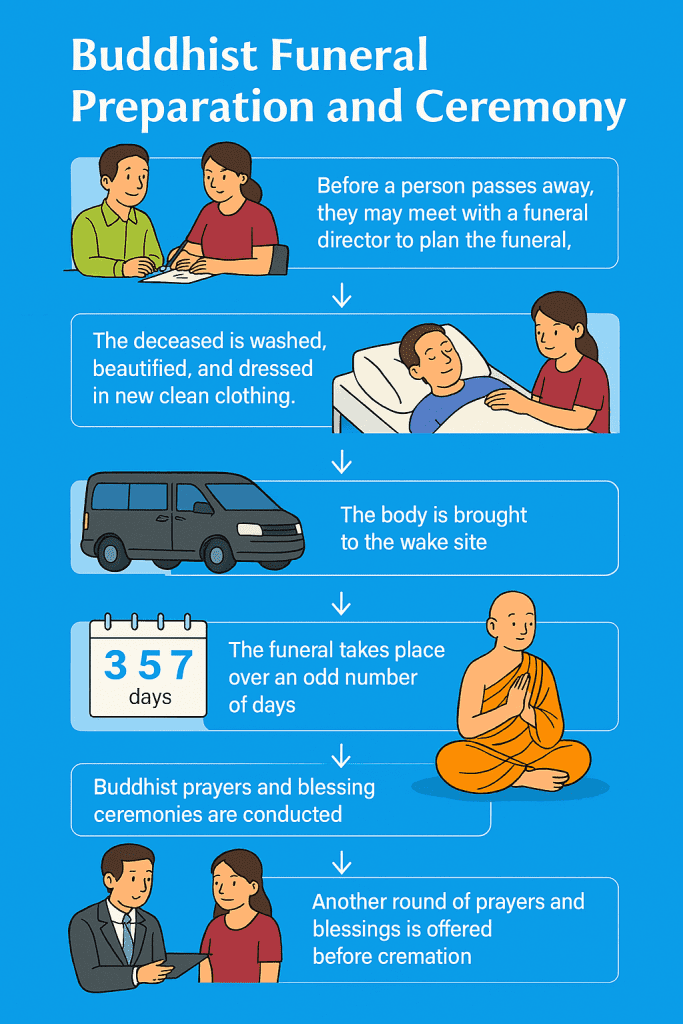
Before a person dies away, some may prefer to prepare their own funeral. If they feel that their time may soon come or if they just want to make the process simpler for their relatives, they can meet with a funeral director to discuss the specifics of the funeral beforehand.
When death happens, the dead will be washed, beautified and dressed in new clean clothing. The funeral is then arranged up the day the person dies away or the following day, depending on circumstances.
The corpse will be carried to the wake site to hold the funeral ceremony, often conducted over an odd number of days, such as three, five or seven days. During the duration of the wake, friends and relatives may come and visit any time to pay respects and give condolences.
Depending on each family’s taste or beliefs, some may elect for Buddhist prayers and blessing ceremonies to be done on the first, third, fifth and seventh day of the funeral, while others opt to conduct it just on the first and seventh day.
In addition, a Buddhist monk will offer another round of prayers and blessings before going off for cremation.
Funeral directors at Singapore Casket will curate the funeral service for the dead as well as the family, including advice on whether to go for cremation or burial services, and also on topics like the ultimate resting site of ashes settlement, etc.
Common Buddhist Funeral Traditions
In Singapore, if a Buddhist funeral is performed at a void deck, yellow and white tentage is placed up over the whole space or around the coffin. White symbolises purity whereas yellow symbolises enlightenment and compassion.
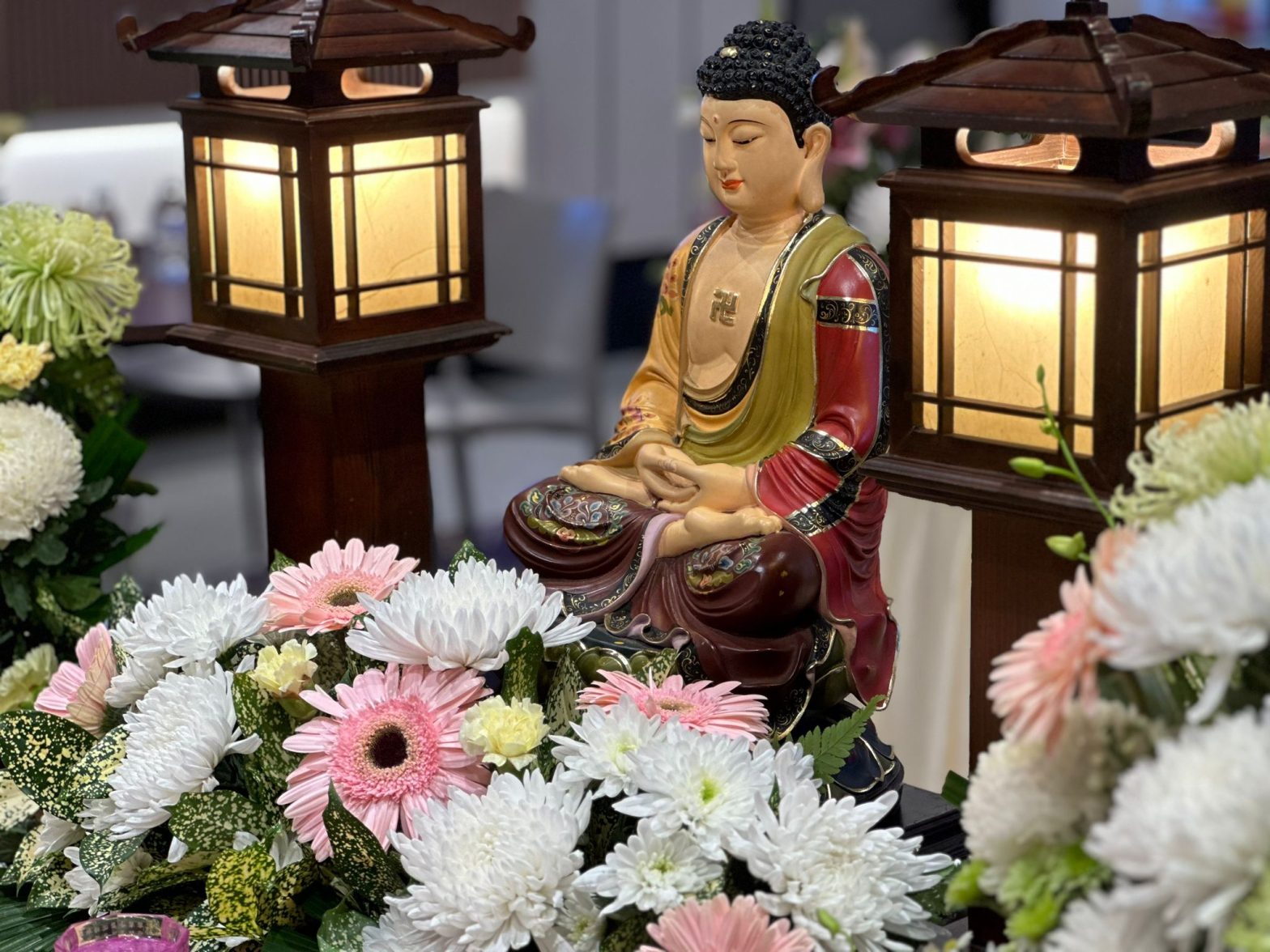
During a Buddhist funeral wake, a picture of the departed together with flowers, fruit, incense, and Buddha statues or images are put in front of a coffin. Vegetarian cuisine is commonly offered during a Buddhist funeral as it symbolises purity, non-violence (ahimsa), and compassion — core values in Buddhism. In Singapore, the burning of paper effigies is optional, depending on the preferences of the family.
It is also normal tradition to continue to give prayers (sutras) and perform Buddhist blessing ceremonies every seven days up to the 49th day after the death of the dead. In addition, it is also customary tradition to perform prayers and Buddhist ceremonies on the 100th day of the passing.
Some think that karma impacts the resurrection process, and that amassing good karma and merits for the departed would benefit them in their trip in the afterlife.
It is for this reason that before and after the death of a loved one, their friends and relatives would endeavor to perform good actions and conduct additional prayers and blessing ceremonies to assist the deceased earn merits. Friends and family may also undertake good actions or give to charity in the name of the dead to redirect the merits to the departed.
Buddhist Funeral Etiquette
These are some dos and don’ts based on popular Buddhist funeral rituals.
It is advisable for friends to tell the family before attending the wake.
It is acceptable to send a sorrow card, flower wreaths, blankets, or condolences cash.
It is normal for family members and close friends to aid with funeral costs by donating sympathy money.
When coming at a funeral, attendees might approach the altar to give a few words of blessings and make a prayer. Paying your respects with joss sticks is a typical habit but you may also offer a prayer and bow as well if the occasion permits otherwise. Any thoughtful gesture is appreciated.
What to Wear at a Buddhist Funeral?
Is there a Buddhist funeral clothing code? When deciding up your wardrobe, avoid vibrant and flamboyant garments.
Guests should strive to wear drab colored attire. Jewellery of any type may also be considered as ostentatious and insulting, so try to avoid wearing them to a Buddhist funeral.
Buddhist Funeral Prayers and Chants
When the Buddhist monks start their chanting and prayer (sutras), normally only the family members are needed to participate in. It is optional for others.
If you would like to participate in the Buddhist prayers, scriptural booklets will be supplied to lead you along. If you do not choose to partake in the prayers, you should stay respectfully quiet until the finish of the rites.
In general, there are not many stringent restrictions that attendees are supposed to observe while attending a Buddhist funeral. For the most part, you should simply be modest and be courteous.
The officiant will provide clues about when you should sit or stand throughout the rites and the funeral director is available if you have any concerns about how you should respond.
The Role of a Funeral Director
A funeral director, or funeral undertaker, is a professional in charge of every element of the funeral service – from planning a wake to making arrangements with funeral parlours, crematoriums, and graves.
He curates the full funeral process, from the commencement till the last parting ceremony before moving out to give the cremation service at the crematorium. By designing and curating the timetable and flow of the whole funeral program, the funeral director helps to make the whole process more bearable for bereaved families.
Nowadays, it is highly popular for people to put the funeral director in charge of Buddhist funeral rituals as they possess wide knowledge of numerous faiths and cultures and are more than capable of offering a befitting sendoff for the dead.
Buddhist Funeral Service & Package
We believe in delivering respectful and meaningful funeral ceremonies so that a loved one’s spirit may be led properly in the hereafter.
To us, it is more than simply a basic ceremony. We want to assist mourning families display their last acts of love and devotion onto their loved one who has gone so that the healing process may begin and closure can be attained.
At FuneralServices.sg, we offer a dignified and complete 3-day Buddhist funeral package tailored for families who seek meaningful and traditional Buddhist rites. Our team ensures the entire process is handled with care, from embalming to the final farewell.
Transparent Pricing (Before GST)
- Wake at HDB Void Deck / Multi-Purpose Hall: From SGD 4,800+
What’s Included in This Package:
Professional Care & Funeral Day Services
- Panel-shape coffin with viewing glass
- Collection and transfer of the deceased
- Funeral day assistance by experienced staff
- Professional embalming in a private air-conditioned theatre
- Body bathing, dressing, makeup and grooming
- Mercedes Vito hearse
- 40-seater air-conditioned bus (two-way trip for guests)
Memorial Setup
- Photo enlargement (10” x 12”) + passport-sized photo
- Floral arrangements: photo wreath and altar table setup
- Condolence booklet and secure safe box
- Flower water for ritual cleansing
- Digital information signage for guests
- Religious magnetic banner
Buddhist Rites
- Full Buddhist funeral service, including chanting sessions by monk:
- Encoffining
- Final night of the wake
- Funeral day
- Buddhist prayer items and altar setup
- Three sets of vegetarian offerings
Cremation
- Mandai cremation fee
- Ashes collection service
Wake Location Options:
- 24-hour access
- Fully air-conditioned
- Smart TV, Wi-Fi, designer lighting, sofa seating
- Daily hall cleaning
- Free use of fridge/chiller
- Daily makeup check by mortician
- Coffee machine available
- Overnight stay permitted
HDB Void Deck / Multi-Purpose Hall
- Tentage, drapery, and carpet around casket
- Tables, chairs, chair covers, lighting and fans
- Mobile toilet provided
Jade Hall not included in promotion. Other halls available upon request.
Optional Add-ons (Additional Charges Apply)
- 49-Day Prayer Services
- Paper House Offerings
- Mourning Garments
- Chiller, catering, drinks and snacks
- Niche, columbarium booking
- Live music/band services
Find out more information about our Buddhist funeral services.
Buddhist Funeral Summary
Buddhist Funeral Summary (Singapore)
| Section |
Key Points |
| Is Buddhism Unique? |
- Mahayana is the dominant school in Singapore.
- Core beliefs: compassion, karma, rebirth, and nirvana.
- Karma impacts future rebirth and quality of life.
|
| What is a Buddhist Funeral? |
- Held if deceased/family chooses Buddhist rites.
- Common venues: void decks, homes, parlours, or outdoors.
- Officiated by a monk; coordinated by a funeral director.
- Cremation typically follows the ceremony.
|
| Funeral Procedure |
- Funeral can be pre-arranged.
- Body is washed, dressed, beautified.
- Wake usually lasts 3, 5, or 7 days.
- Prayers on selected days (1st, 3rd, 5th, 7th).
- Final prayers by monk before cremation.
|
| Common Traditions |
- Yellow and white tentage represent enlightenment and purity.
- Altar includes photo, incense, fruit, flowers, Buddha statue.
- Vegetarian food served; paper effigies optional.
- Rituals continue every 7 days until the 49th day and also on the 100th day.
- Good deeds and charity in the name of deceased for merit.
|
| Funeral Etiquette |
- Inform the family before attending.
- Gifts: condolence money, flowers, cards, blankets.
- Pay respects with joss sticks, bows, or silent prayer.
- Financial contributions help cover funeral costs.
|
| Attire Guidelines |
- Avoid bright or flashy clothes.
- Wear dull or neutral colours.
- Avoid jewellery or flashy accessories.
|
| Prayers & Chants |
- Family usually participates in chanting.
- Visitors can join quietly or follow along with provided scripts.
- Respectful behaviour is expected throughout the rites.
|
| Role of a Funeral Director |
- Oversees the entire funeral process.
- Coordinates venue, rituals, cremation, and post-funeral services.
- Helps ease the burden on the family with professional support.
|